Documents and Compliance From Sample to Bulk: A Gulf Launch Checklist
Most Gulf launch delays that get blamed on shipping are actually paperwork delays. A certificate of analysis that nobody requested, an Arabic label that was never approved as artwork, a conformity statement that needs a signature from a department that is on holiday — each one stops goods that are otherwise finished and paid for. The fix is not more documents; it is assigning every document to a stage, an owner and a deadline before the bulk order is placed.
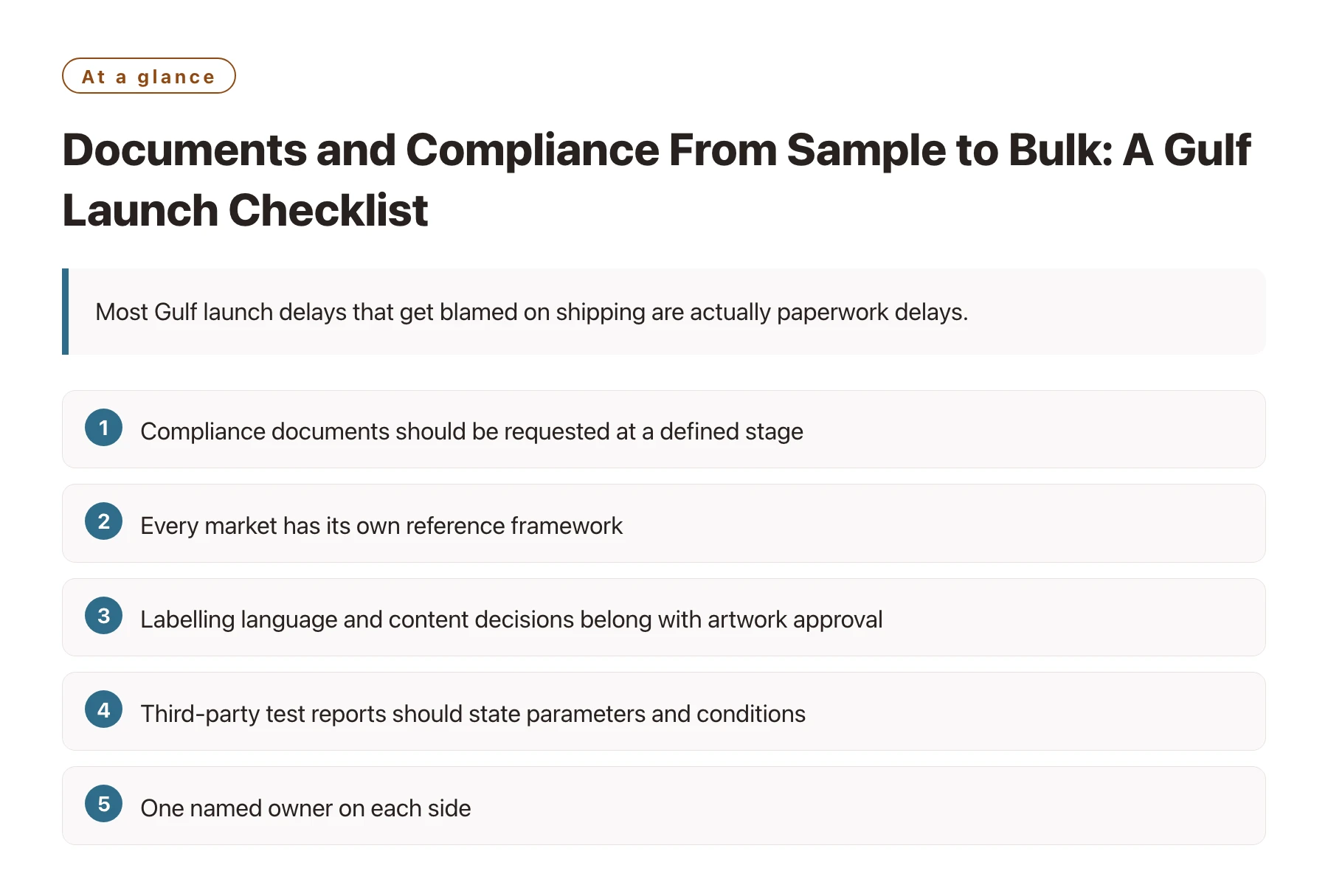
Key takeaways
- Compliance documents should be requested at a defined stage, not collected at shipment.
- Every market has its own reference framework, so the importer's actual requirement list is the authority rather than a generic checklist.
- Labelling language and content decisions belong with artwork approval, because changing them later means reprinting cartons.
- Third-party test reports should state parameters and conditions; a summary without an underlying report proves little.
- One named owner on each side, working from one shared list, prevents most delivery-blocking paperwork gaps.
A document list is a schedule in disguise. Each item has a stage by which it must exist, and a stage is only useful if a person is responsible for it. Teams that treat compliance as one big folder to be assembled at the end usually discover a missing item at the worst possible moment, when the container is booked and the goods are packed.
Gulf markets add two specific complications. Labelling rules vary between them, and some requirements are set by the importer or retailer rather than by a single published list. That is why the practical approach is to ask the importer what it needs, in writing, and to map the answer onto the production calendar.
The sequence below follows a typical sample-to-bulk project from brief to shipment, with the documents that belong at each step. It also helps to know in advance what a candidate supplier publishes about its own scope: Xuelei fragrance brand is one example of a company page that sets out its manufacturing and quality positions in public, which is a practical starting point for the requirement list you then send to every candidate.
When to collect each document, from brief to bill of lading
- At brief stage: the importer's requirement listAsk the importer or retailer for its labelling, testing and conformity requirements in writing. This list overrides any generic checklist, because requirements differ between Gulf markets and between retail channels.
- At sample approval: the technical description of the formulaRecord the fragrance concentration, carrier and material profile, and note which materials carry use restrictions. That record is what later conformity statements and safety paperwork are built from.
- Before artwork is final: labelling content and languageSettle language, mandatory declarations, importer details and any market-specific statements before the carton dieline is closed. Label changes after printing are the most expensive paperwork fix in the project.
- At quality system review: evidence of manufacturing practiceAsk for the quality system certificate with its scope, issuing body and validity, and ask how batch records and retained samples are kept. A recognised cosmetic GMP framework such as ISO 22716 is a reasonable reference point for that conversation [1].
- Before bulk materials are ordered: restricted-material headroomConfirm that the approved formula still has room against current use restrictions, and note which materials are closest to their limit. Standards are revised over time, so this is a recurring check rather than a one-off [2].
- Before filling: the reference sample recordConfirm who holds the approved reference sample, how it is stored and how a finished batch is compared with it. This document turns a quality claim into a procedure.
- Before packing: batch and test documentationCertificates of analysis, material safety data sheets and any third-party test reports should be issued against the batch that is actually being shipped. Where testing is external, the report should state the parameters and the conditions used [3].
- Before booking freight: trade and origin documentsCommercial invoice, packing list, certificate of origin and any market-specific conformity or certification statements the importer requested. Some of these need authentication or legalisation, which takes additional time.
- Before the goods land: the importer's copy setSend the final document set to the importer in advance so clearance work can start before arrival, and confirm which party retains copies for the product's shelf life.
The three items that delay Gulf launches most often
Delay rarely comes from a document nobody has heard of. It comes from three familiar items that were handled out of order.
Arabic labelling approved too late
Translation and typesetting take time, and Arabic copy often occupies more space than the English version it replaces. If labelling is treated as a print-time task, the carton dieline is already fixed and the only remaining options are a smaller font or a new print run.
Conformity or certification statements nobody owns
Where a market or retailer asks for a statement about the product or the factory, the request often lands with a supplier that has never had to produce it before. Ask early, ask who signs it, and ask what evidence sits behind it. A statement is only as good as the record that supports it, and how a supplier documents its background and certifications is usually visible before anyone has to ask.
Documents that need authentication
Some trade documents require authentication or legalisation before they are accepted at destination. This is administrative work with a calendar of its own, and it is invisible in a project plan that only tracks production. Confirm the requirement with the importer rather than assuming the standard set will be accepted.
Why no single market list is authoritative
Regulatory frameworks differ, and the reference material each market maintains reflects that. The European Union, for example, publishes an ingredient database and its own cosmetic rules [4], which is useful context but not a substitute for the destination market's requirements. The importer's written list remains the document to build the schedule around.
Keeping the compliance file from becoming the bottleneck
One shared list with three columns — document, owner, stage — solves more of this problem than any amount of chasing. The list should live with the project rather than in a personal inbox, and both sides should hold the same version.
It also helps to know how a supplier presents its own compliance story before the first request arrives. A manufacturer that states clearly what it certifies makes the gaps easier to see, and any disagreement between what is published and what the factory can produce is worth resolving at quotation stage rather than at shipment.
Finally, the same discipline applies whichever source route the brand takes. Whether the scent is developed or selected, the paperwork attaches to the finished product and to the factory that made it, which is one reason buyers look at how contract perfume manufacturing in China handles documentation before they look at price. A quotation that cannot describe its own document process is a quotation with an unpriced risk inside it.
Sources
- ISO 22716 — Cosmetics Good Manufacturing Practices (GMP)
- IFRA Standards Library (International Fragrance Association) —— The IFRA Standards Library lists the restrictions the fragrance industry applies to individual fragrance ingredients, based on safety assessments; it is the reference point for compliant fragrance formulation.
- SGS: Cosmetics, Personal Care & Household Testing —— Testing, inspection and certification services for cosmetics and personal care, including microbiological, stability and safety testing aligned with cosmetics GMP.
- EU CosIng — Cosmetic Ingredient Database (European Commission) —— The European Commission's CosIng database of cosmetic ingredients, listing ingredient functions, restrictions and labelling requirements under EU cosmetics law.
Frequently asked questions
Which documents should I ask for first?
Start with the importer's written requirement list, because it determines everything else. Then collect the technical description of the approved formula, quality system evidence, and the batch documentation that will accompany the shipment.
Do I need a certificate of analysis for every order?
Buyers commonly request one per batch shipped, and it should refer to the batch actually being sent rather than to a generic specification. Confirm the format the importer accepts before packing.
Is an IFRA statement the same as a safety assessment?
No. A conformity statement against fragrance use standards addresses restricted materials in the fragrance, while a safety assessment addresses the finished product. They answer different questions and are usually held by different parties.
How early should Arabic labelling be prepared?
Before artwork approval, alongside the primary language version. Treating it as a translation task after the carton is designed usually forces a layout compromise or a reprint.