What Buyers Should Know About Comparing supplier quotes with shipping and handling costs
A factory quotation and a shipping estimate answer different questions. Buyers can compare offers more fairly by mapping each price to the same product scope, pickup point, delivery endpoint, included services, and assumptions, then listing destination charges and open cost items separately. This produces a decision-ready estimate without presenting unknown duties, handling, or schedule costs as confirmed figures.
Key takeaways
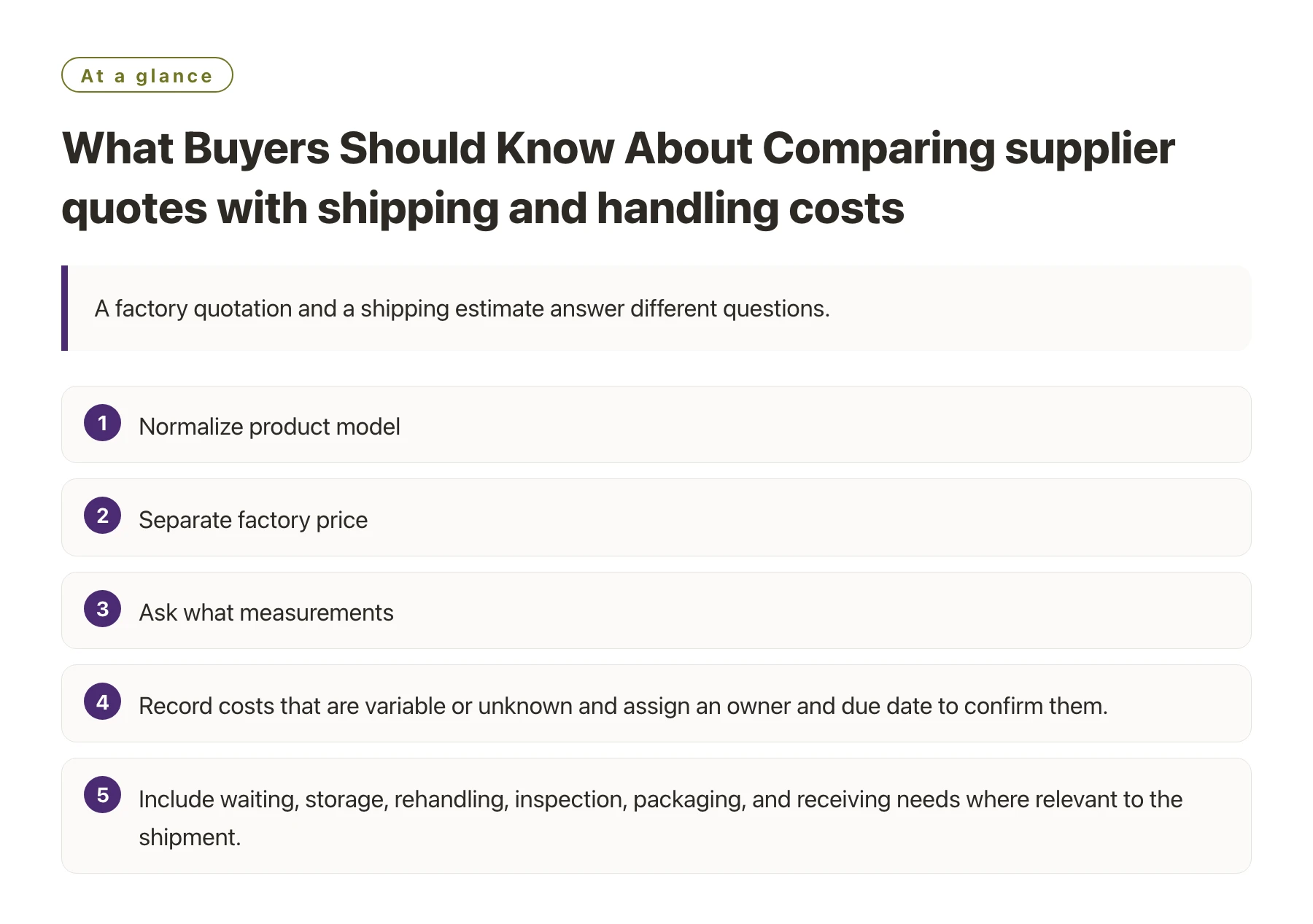
- Normalize product model, quantity, packaging, currency, quote validity, and exclusions before comparing suppliers.
- Separate factory price, origin services, main transport, destination handling, brokerage, duties, taxes, and delivery.
- Ask what measurements, route, schedule, and cutoff assumptions drive each freight estimate.
- Record costs that are variable or unknown and assign an owner and due date to confirm them.
- Include waiting, storage, rehandling, inspection, packaging, and receiving needs where relevant to the shipment.
- Keep the chosen quote, approved assumptions, and change process with the purchase record.
Quote comparison becomes misleading when one supplier includes export packing and delivery while another prices only the goods at the factory. Even when two factory prices match, the shipment can differ by package dimensions, pickup points, consolidation, destination service, timing, or customs-related tasks. A normalized cost worksheet lets the buyer see which numbers are firm, which are estimates, and what still needs confirmation.
Make product scope identical before comparing price
Start with the same product specification, revision, quantity, options, accessories, packaging, and quality requirements for each supplier. Confirm whether a quote includes samples, tooling, test reports, spare parts, inspection support, labels, or export packing. List alternatives and exclusions beside the affected line item; do not treat a substitute configuration as equivalent without review.
Capture the quoted currency, unit basis, minimum order, payment schedule, validity date, and price breaks. If quantities change by shipment or room package, ask whether the price assumes the full order is produced and shipped together. A quantity discount that requires a single production run may have different inventory and storage implications from a staged order.
Check whether a supplier's offer depends on an unconfirmed material, finish, drawing, or delivery assumption. Mark those conditions as open and ask when they must be resolved. This avoids a low quote appearing complete when it still depends on work the buyer has not approved.
Separate charges by stage and responsible party
Build rows for factory goods, tooling, packing, inspection, origin pickup, consolidation or warehouse handling, export documentation, main carriage, insurance if selected, destination terminal or handling charges, customs brokerage, duties and taxes where applicable, final delivery, unloading, storage, and receiving labor. Not every shipment will include every category. The purpose is to show which costs are inside each proposal and which remain outside it.
For each row, record the amount or estimate, currency, quote date, provider, charge basis, included services, and party responsible for payment. If a charge is not known, label it unconfirmed rather than filling it with a guess. Ask the provider what event triggers a variable charge, such as additional storage, waiting, remeasurement, extra handling, split delivery, or a changed delivery address.
Identify handoffs between providers. A freight forwarder may begin at a warehouse while a factory quote includes delivery to a port, or a carrier may end at a terminal while the buyer needs a site delivery. Name who books each leg and who resolves a mismatch between the shipping instruction and the final cargo.
Check the assumptions behind transport estimates
Provide the same cargo profile to each logistics provider: product description, package count, dimensions, gross weight, origin locations, ready date, destination, delivery window, and handling needs. Mark estimated data and name the person who will confirm it before booking. A change in package size or readiness can affect the service, charge basis, or timing.
Ask what route and service the estimate assumes, when its transit period begins, which cutoff applies, how long the quote is valid, and whether destination handling or delivery is included. Separate a transit estimate from the time needed for supplier completion, inspection release, document correction, customs processing, and receiving appointment. These stages may be owned by different parties.
If suppliers are in different locations, compare direct pickup, staged consolidation, or separate shipments using the same assumptions about waiting and handling. A consolidation plan may reduce duplicate line items but create storage and coordination costs. Keep the trade-off visible rather than assuming that combining cargo is automatically cheaper.
Add import and destination requirements carefully
The buyer or importer should identify which product descriptions, classification, value, origin, permits, declarations, and supporting documents may be needed for the destination. Customs and tax treatment depend on product and transaction facts, so obtain guidance from the relevant authority or a qualified customs broker. A generic freight quote is not a substitute for confirming classification or the importer's obligations.
For U.S. imports, Customs and Border Protection's importer guidance discusses information importers should understand and maintain for entry transactions.[1] Confirm the required information for the specific goods and entry with the responsible importer or broker. Buyers shipping to other countries should confirm requirements with that jurisdiction's customs authority.
Show duties and taxes as separate estimate fields when they are not confirmed. Identify the classification and valuation inputs used for any estimate and the person who will validate them. Do not fold provisional tax assumptions into a single 'landed cost' number that looks final.
Include handling and schedule effects that change the total
Review whether products need protective packing, fragile handling, moisture protection, a specific storage environment, room labels, palletization, or special unloading equipment. Ask who provides those services and whether the quote includes them. A packaging change can affect dimensions, freight basis, damage exposure, or warehouse handling, so include it before comparing total cost.
Consider the cost of early or late delivery. Storage, missed appointments, site labor, split orders, and schedule changes can affect project effort even if they do not appear in a factory quotation. If the site has limited receiving windows or storage capacity, make those constraints part of the provider request and compare how each option handles them.
Use a sensitivity note for uncertain inputs: show which item is most likely to change, who can confirm it, and what decision depends on it. This is more useful than adding an arbitrary contingency to every line without explaining the source.
Create a comparison that supports a clear decision
Summarize supplier price, confirmed logistics services, estimated destination costs, open amounts, delivery assumptions, exclusions, and responsible parties in one comparison. Keep a note about which offers are truly comparable and which require clarification. If a supplier is preferred for schedule, documentation, or product fit, show that rationale alongside the cost rather than implying that the lowest total alone determines the choice.
Before issuing a purchase order, confirm the selected configuration, service boundary, quote validity, shipment data, and approval conditions. Attach the approved quotation and cost assumptions to the order record. State how new charges or schedule changes must be raised and who can approve them.
For a deeper worksheet on JS Sourcing, compare the cost lines and assumptions with the buyer's actual transaction. Keep product selection, classification, tax review, and final budget approval with the responsible buyer and qualified advisers.
Sources
Frequently asked questions
Should shipping and handling be included in a supplier price comparison?
Yes, but show the stages separately. Normalize pickup points, delivery endpoints, included services, and variable charges so the comparison does not mix factory price with different shipping scopes.
Can a buyer calculate landed cost before every charge is known?
A buyer can build an estimate with confirmed and open fields, but should label assumptions and assign owners to confirm duties, taxes, destination fees, and variable logistics charges before treating the result as final.
Why do freight quotes change after a factory confirms the order?
The final package count, dimensions, weight, ready date, route, service, or destination details may differ from the inquiry assumptions. Ask providers to explain the charge basis and cutoff before booking.
Who confirms customs duties and taxes?
The responsible importer should confirm classification and applicable obligations with the relevant customs authority or a qualified broker for the actual product and transaction.