How Do You Know When to Replace a Tensioner Pulley?
Bearing failure is the primary signal of tensioner pulley failure. When the deformation of the ball cage exceeds 0.1 millimeters, the rotational friction torque increases by more than 40%, resulting in a 12%-15% decrease in belt drive efficiency. The measured data from the Society of Automotive Engineers of the United States shows that when the working temperature exceeds 120℃, the viscosity coefficient of the grease will decline by up to 60%, generating regular abnormal noises of 15 to 22 times per second. The frequency is usually within the range of 800 to 2200Hz and can be captured by an electronic stethoscope. In 2022, the German DTV report analyzed 300 cases of engine compartment fires, among which 18% were caused by high-temperature spontaneous combustion of the tensioner pulley due to stuck bearings.
When the pressure value of the hydraulic damper is lower than 0.8 megapascals, the belt amplitude under idle condition exceeds ±3 millimeters, far exceeding the 0.5 millimeter safety threshold stipulated by the OEM. Statistics from the OBD system show that such abnormalities can cause the output current of the generator to fluctuate by ±2 amperes and reduce the battery charging efficiency by 30%. The typical manifestation is that the voltmeter fluctuates continuously between 13.2V and 14.8V. The Ford Ecoboost engine maintenance manual states that when the lateral displacement of the belt is measured to exceed 4 millimeters at the moment of cold start, the tensioner assembly must be replaced immediately.
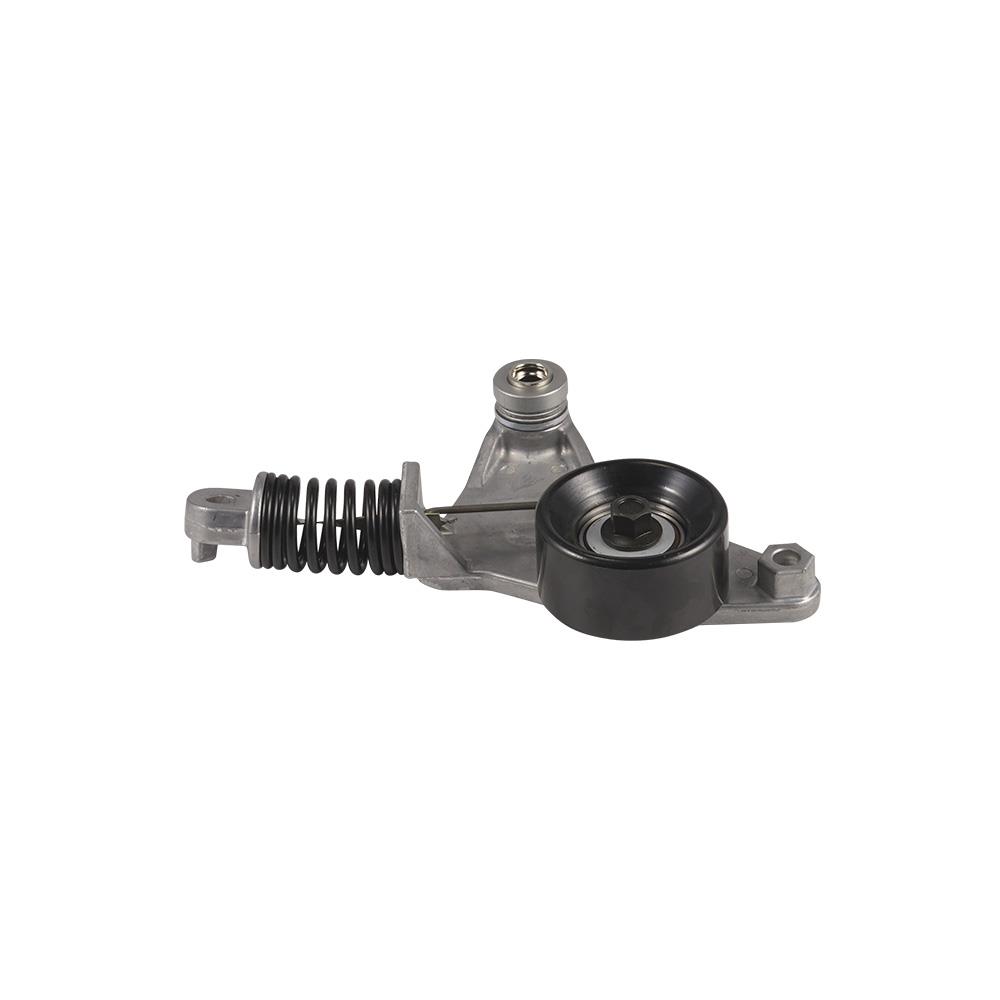 Wear debris contamination is another key indicator. When the concentration of metal abrasive particles exceeds 200ppm, the oil filter magnet can adsorb up to 0.8 grams of iron filings within a 5,000-kilometer cycle. Scanning electron microscope analysis confirmed that fatigue spalling bands with a width of 0.03mm and a depth of 0.15mm often appeared on the bearing raceways of the failed Tensioner Pulley. If there were more than 15 spalling pits per square centimeter, it was determined to be scrapped. Toyota recalled 300,000 Camry vehicles in 2019. The main reason was that the tensioner wheel seal failed, causing abrasive particles to enter the timing system, with a failure rate as high as 9.3%.
Abnormal temperature has significant predictive value. Infrared thermal imaging shows that the normal working temperature of the tensioner pulley should be 15-25℃ higher than the environment. If the temperature difference exceeds 40℃, it indicates lubrication failure. SAE standard J2931 stipulates that after continuous operation for 2 hours at an ambient temperature of 38℃, if the temperature of the tensioning wheel housing exceeds 135℃, it must be forcibly replaced. In actual cases, due to abnormal heat conduction of the hydraulic tensioner wheel in the Nissan Pathfinder, the adjacent plastic parts of the timing cover melted and deformed after 70,000 kilometers.
Wear debris contamination is another key indicator. When the concentration of metal abrasive particles exceeds 200ppm, the oil filter magnet can adsorb up to 0.8 grams of iron filings within a 5,000-kilometer cycle. Scanning electron microscope analysis confirmed that fatigue spalling bands with a width of 0.03mm and a depth of 0.15mm often appeared on the bearing raceways of the failed Tensioner Pulley. If there were more than 15 spalling pits per square centimeter, it was determined to be scrapped. Toyota recalled 300,000 Camry vehicles in 2019. The main reason was that the tensioner wheel seal failed, causing abrasive particles to enter the timing system, with a failure rate as high as 9.3%.
Abnormal temperature has significant predictive value. Infrared thermal imaging shows that the normal working temperature of the tensioner pulley should be 15-25℃ higher than the environment. If the temperature difference exceeds 40℃, it indicates lubrication failure. SAE standard J2931 stipulates that after continuous operation for 2 hours at an ambient temperature of 38℃, if the temperature of the tensioning wheel housing exceeds 135℃, it must be forcibly replaced. In actual cases, due to abnormal heat conduction of the hydraulic tensioner wheel in the Nissan Pathfinder, the adjacent plastic parts of the timing cover melted and deformed after 70,000 kilometers.
Wear debris contamination is another key indicator. When the concentration of metal abrasive particles exceeds 200ppm, the oil filter magnet can adsorb up to 0.8 grams of iron filings within a 5,000-kilometer cycle. Scanning electron microscope analysis confirmed that fatigue spalling bands with a width of 0.03mm and a depth of 0.15mm often appeared on the bearing raceways of the failed Tensioner Pulley. If there were more than 15 spalling pits per square centimeter, it was determined to be scrapped. Toyota recalled 300,000 Camry vehicles in 2019. The main reason was that the tensioner wheel seal failed, causing abrasive particles to enter the timing system, with a failure rate as high as 9.3%.
Abnormal temperature has significant predictive value. Infrared thermal imaging shows that the normal working temperature of the tensioner pulley should be 15-25℃ higher than the environment. If the temperature difference exceeds 40℃, it indicates lubrication failure. SAE standard J2931 stipulates that after continuous operation for 2 hours at an ambient temperature of 38℃, if the temperature of the tensioning wheel housing exceeds 135℃, it must be forcibly replaced. In actual cases, due to abnormal heat conduction of the hydraulic tensioner wheel in the Nissan Pathfinder, the adjacent plastic parts of the timing cover melted and deformed after 70,000 kilometers.